top of page

This is the second in a series of articles taking a brief look at the pros and cons of the various multi-dealer book listing databases. The first in the series looked at AbeBooks.com and can be found in the previous issue. This article examines Alibris.com, which was the first “on-line” site developed under the name of Interloc (in pre-internet days), and the site which has undergone the most dramatic and significant changes over the years.


Interloc, which was founded in 1994 by Richard Weatherford with Tom Sawyer and Brad Councilman, was perhaps one of the most important factors in introducing booksellers—especially those with open stores—to the use of computers in their business. Initially, it was a closed business-to-business only service, which gave sellers the ability to upload information on thousands of books, to get want matches daily, and to search for books for their customers. It was also a rather expensive service, although less so than running an ad in AB Bookman’s Weekly, the only real alternative at the time. With hourly phone charges and listing fees, it was far more expensive both to run and to participate in than the public sites which later appeared on the internet in 1996—notably Bibliofind.com and AbeBooks.com. Late in 1996, Interloc also opened a public internet website, but it had already lost some ground among booksellers as the third such site (personal note: since we were Mac users as booksellers, we were never able to upload to Interloc back in those days).


In 1998, there was a drastic change: the old Interloc was bought out, or merged into, a new company called Alibris.com. Rather than simply being an “internet classified listing service” for booksellers (as they referred to Bibliofind and Abe), Alibris was going to be a bookseller itself. While booksellers could still upload their inventory to Alibris (and in fact, Alibris purchased Bibliocity.com at least in part to enhance their ability to accept more files, for example, from Mac users), the dealers’ prices were increased by a certain percentage; the individual bookseller’s name was not associated with a specific book; and there were no costs to the bookseller until a book was sold to a customer, at which point Alibris “bought” the book from the seller for a 20% discount, and the book was shipped to the Alibris warehouse. Flush with venture capital funding, Alibris bought extensively for its own inventory (including the entire stock of some booksellers), developed a warehouse in the Reno area (at one time it offered listing/warehousing/shipping services to booksellers on a consignment basis), and advertised extensively. Most significantly, it developed several partnerships with libraries and other businesses like Ingrams, Borders, and others, most of which continue to this day.


While Alibris described its new business model as similar to that of a traditional bookseller, in reality, in less than 2 years the other listing services had created new expectations among booksellers: low flat fees for listing, direct contact between buyers and sellers, the advertising benefits of having your business name associated with your inventory and more. Over the past few years, Alibris has moved back towards this “new traditional” Internet model. While Alibris remains a bookseller itself, it changed its focus from rare and out-of-print to remainders and new books. It also began charging a flat monthly fee for all but the smallest sellers, reduced its commission on retail sales from 20% to 15%, listed books on the website at the same prices that individual sellers put on them, increased seller visibility, had sellers ship directly to buyers in the US (thus reducing the costly and time-consuming shipments to the warehouse), and made direct contact between buyers and sellers possible.


FOR BUYERS: PROS


– Extensive use of coupons and discounts. These, combined with “flat” and relatively low shipping rates set by Alibris, often means that a buyer can obtain a copy of a book on Alibris for less than on the competing services.


– Reliability of sellers. ALONE of the three big “A’s” Alibris seems to be making a serious effort to exclude “sellers” who are just data uploaders or who do no more than “spider” other listings and then offer these books (which they do not actually have in stock) at inflated prices. Alibris might not be perfect in this regard, but at least they are trying.


– “Protection” of your order in the shopping cart for 12 hours. If you select a book and put it in the shopping cart, it is removed from public sale for up to 12 hours, thus giving the buyer time to look around and select other books.


– Reasonable shipping fees. Set by Alibris (and almost identical to those set by Amazon). In addition (unlike Amazon), Alibris offers reduced shipping on additional books when purchased from the same bookseller. Buyers should be aware of the fact that not all of the shipping fees are passed on to the sellers (again this is identical to Amazon). Some are retained by Alibris to help fund programs like the discount coupons.


– A large database. 60 million books are claimed on the website, and in 2006, Alibris had approximately 8,000 active sellers. While this was reported as a reduction in numbers from previous highs, it represented only active sellers. Recently Alibris has opened listings up to individuals who might just want to sell a few books (as Amazon did long ago), but it is too soon to see what effect this will have on the overall inventory.


– For buyers looking for a reasonably priced reading copy of a book, the summary results (by title) and the “quick buy” suggestions can speed up and simplify searches. However, these same features become a negative when searching for specific features, such as first edition, as discussed below in the Cons.


– For collectors, Alibris permits the listing of uncorrected proofs and advance reading copies (ARCs) after the book has been published.


– Consolidated ordering and billing services for libraries. While the prices of the books might be slightly higher, this is probably more than offset by the increased convenience and savings in handling.


– Offers want matching (called “fetch book”). However, even though Interloc pioneered want matching capabilities, Alibris’s system seems to be less effective. For example, I put in a match request and received a notification that there were no matches, but an actual search using the exact same parameters brought up 62 results.


– Reliability ratings. While Alibris tells buyers that these ratings only reflect book availability (with the highest rating meaning “almost always available”) and does not reflect quality of dealer service, the buyers are not told precisely what the ratings mean in terms of percentage of completed order. 3 dots means “often available” but this can be as low as 70% of the time.


FOR BUYERS: CONS


– Difficulties in searching. Especially for more uncommon books or for collectible books like signed or first editions. Unlike the traditional search engines, Alibris searches first its own bibliographic database of several million “most commonly searched for” books and gives as matches the books found in that database. If you do a title search for an uncommon book, you might get back a book with a similar title but not the book you are looking for. If you “narrow” your search by adding the author, then the search will find the exact book, since it now looks at the actual listings uploaded by dealers. This is designed to speed up the search results, but is often counter-intuitive. (Example: title search “Writer on Her Work” will return two “summary” results, for the first volume in this series, and the second with the subtitle “New Essays in New Territories.” If you select the second volume “New Essays” you will see 38 results, all for the trade paperback edition, no hardcovers. If you go to the advance search and put in “Writer on Her Work” and select hardcover, you will get 80 results, some of each title. Adding “first edition” to “hardcover” returns 34 results. If you further narrow the results by adding “signed” to “first edition” and “hardcover” you will get 4 results, including two copies NOT returned in any of the previous searches. This is a neat trick, and I have no idea why these two copies did not show up in either the hardcover or first edition results, but still showed up when all three refinements were selected.)


– Limited and inaccurate keywords. The “keywords” used are not those entered by booksellers but are presumably taken from Alibris’s database. (Example: if you enter “Canadian authors” in the keyword field, you will get 20 pages of title results, but if you sort these results by author, you will see that only three of Margaret Atwood’s many titles are included, but one of Australian author Thea Astley’s books is also listed.) The same problem exists in browsing a single seller’s inventory. The categories are assigned by Alibris and are often very inaccurate and incomplete.


– False results when searching for first edition and signed copies. When Alibris “parses” for first edition, phrases such as “first US” or “first UK” are not accepted as first edition identifiers. Since most of Canadian writer Margaret Atwood’s “true first” printings were Canadian editions, this means that listings by sellers who are careful to correctly identify printings from other countries will be eliminated from first edition searches (unless they use a program with a specific “first edition yes/no” type of box). However, this does not mean that all books listed as “first editions” really are. If you narrow the first 38 search results for “The Writer on Her Work: New Essays in New Territory” by clicking first edition, you will see 3 copies—1 “trade paperback” presumed first and two identified as “second printings.” Sometimes search results for first editions or signed copies on Alibris are more accurate on Bookfinder (if you use the “classic” option on Bookfinder, the Alibris results are easily found).


– Credit card is charged immediately upon placing the order, even though the book has not yet been confirmed as available.


– The only payment method is by credit card. PayPal and checks are not an available option.

– For most international buyers, books are first shipped to the Alibris warehouse and then to the customer, which can increase costs, possibility of damage from additional handling and the time of delivery.


– “Help” pages are not kept up-to-date. Information on returns still gives instructions only on returning the book to the warehouse, rather than the individual seller, and the ability to ask the bookseller directly any questions you might have is not mentioned.


– Minimum price of $1.99 means that a book listed for as little as 1 cent on Amazon or $1.00 on AbeBooks.com will have the price increased on Alibris.com to $1.99.


– Unable to set preferences for search results. Depending on the search, the results default to “by seller rating,” lowest price, or most popular, depending on the search, and have to be manually adjusted for other options each time.


FOR SELLERS: PROS


– Its network of “business partners” which gives booksellers access to many different markets—primarily, the library consolidation feature it offers, uploading to BarnesandNoble.com, Borders, Chapters, and for a small additional fee on sales, it offers sellers the option to have their books uploaded to Amazon’s marketplace.


– Extensive use of coupons, widely available internet discounts and other promotions to increase sales.


– New program which permits those who have a small number of books for sale to list them individually on the site and to incur no fees (after a sign-up fee) until the book is sold. At that time, an additional flat fee of 99 cents is charged in addition to the usual commission.

– An informative and easy to access bookseller page called the “dashboard.” Includes summary information on sales, listings, total value, average sale, etc.


– ISBN look-up features, market value comparisons, and optional automatic re-pricing (however, I will include the caveat that I personally think the comparative values shown are rather inaccurate).


– Email customer support is usually responsive and to the point.


– Moderately active forum for booksellers.


– Reduced commissions on more expensive books. Although Alibris does not have a maximum commission (for example, AbeBook.com’s is $40 regardless of the price of the book), Alibris does have a declining scale for books priced at $500 and more. This can lead to inconsistencies. For example, a book priced at $475 will have a commission of $71.25, one at $525 will be $52.50, and an $850 book will only incur a $42.50 commission. Since this includes credit card processing fees, it means that on sales of all books over $500, Alibris is less expensive than the same book would be on both AbeBooks and Amazon.


FOR SELLERS: CONS


– Search engine results on Alibris.com often do not include your copies. This is the direct opposite of AbeBooks.com. All of the factors that will improve the visibility of your books on AbeBooks will either reduce the chances of “your” copy showing up on Alibris or have no effect at all (see detailed search notes above under the comments for buyers). In addition to the problems already mentioned, listing contributing authors or illustrators in the author field will either have no effect, or can eliminate your copy; the use of keywords, catalogs or subjects are ignored; and books can not be searched by any information included in the description.


– Alibris and its partners consider the buyer as their customer rather than what they really are, which is the customer of the individual bookseller.


– Competes with sellers by offering options and benefits like free shipping, express shipping, etc. only on the books in its own inventory.


– The cost of listing and selling. In addition to a high commission of 15% (20% on some partner programs), Alibris has a flat monthly fee which is a few dollars less than AbeBooks.com, and can be higher than Amazon’s, depending on the number of books listed. Alibris also retains part of the fees charged to buyers for shipping, so when the buyer pays $3.99, the seller only receives $2.65.


– Sellers are told that they are responsible for sales taxes, but there is no provision for collecting sales tax (except in the four states where Alibris has a presence and automatically charges sales tax on all sales).


– Limited uniform shipping reimbursement set by Alibris (can occasionally be adjusted).


– Long delay in receiving payment for sold orders. Payments are made only twice a month and cover orders either marked as shipped or received in the warehouse. Most of the time, this means that there is a minimum 15 day delay that can reach up to 29 days. Four times a year there is an extra Friday in the month and this increases the delay to as long as 36 days.

– No telephone customer support.


Chris Volk operates Bookfever along with Shep Iiams out of the Sierra foothills of Amador County, CA and can be contacted at http://www.bookfever.com.


IOBA Standard, Summer Edition 2007, Volume 8, No. 3.


Buying and selling books on the web is becoming ever more complex, with a bewildering range of sites available, all with different strengths, weaknesses and charges.


This guide is an attempt to give clear summaries of each site.


From the book buyer’s point of view, it should help guide you towards the sites that give best value for the particular kind of books you are looking for. This means, generally speaking, the ones that charge little or no commission and have good ethical control over the booksellers listing on the site.


From the book seller’s point of view, it should give clear information on the costs, and the advantages and disadvantages of each site.


So this guide concentrates on the factors that are important to both the buyer and the seller: the overall cost of listing on each site, how accurately and speedily books can be found within the site, how accurately and well the books are catalogued, the quality and range of the books, the quality and probity of the book sellers who list there and the amount of traffic that reaches the site.


Other factors such as site design and extra features or quirks are left for the users to love or hate as they see fit!


This guide is restricted to English language multiple listing sites with at least ¼ million books listed. Other language sites and single store sites such as B&N, Powell’s, Strand, etc., are not included individually, although some are covered by the metasites. Relisting sites (sites that take in other booksellers catalogues and relist them at a higher price) are also excluded.


Metasites


Metasites are sites that trawl many other listing sites – a ‘one stop shop’. Apart from the slightly longer time they take to complete each search (a significant disadvantage only if you need to look up many titles in one session), they are probably the most complete way to check on the availability and price of any given title. If the title is very common, the metasite may ‘rationalize’ the results to save too many being displayed. You can always go on to an individual listing site if you wish to expand the results.


The metasites do not charge commission, and the prices they display will reflect the charges of the listing site they are reporting. To appear on a metasite, all a book seller has to do is to join at least one of the listing sites that the metasite covers.


The Metasites

Covers the following sites: ABE, Alibris, AntiQbook, Biblio, Biblion, Bibliophile, Bibliopoly, Books&Collectibles, ChooseBooks/ZVAB, HalfCom, ILAB, MareMagnum, Powell’s, Strand.


Features:


* but can reach only sites that support wild card. ** Typical search times are assuming a

fast web connection and an average time of day. If you have a slower connection or

search at a busy time, the search times may be longer.

Traffic (Alexa): 92.  Linkage (Google): 501.

Extra feature: Displays a quotation to keep you interested while it searches.


BookFinder.com  http://www.bookfinder.com

Covers the following sites: A1Books, A1TechBooks, ABE, AbookSearch, Alibris, Amazon (all sites), AntBo, AntiQbook, B&N, Biblio, Biblion, BiggerBooks, BookAvenue, BookBestBuy, BookByte, BookCloseOuts, Books&Collectibles, Buy, Chapitre, ChaptersIndigo, ChooseBooks/ZVAB, Dymocks, EBay (partial), Ecampus, ElephantBooks, GlobalBookMart, Half, HalfPriceComputerBooks, ILAB, MareMagnum, Overstock, Powell’s, TextBookX, TheBookCellar, TomFolio, TotalCampus, UsedBookCentral, ZVAB.

Features:


* Some automatic alphabetisation.              ** in Classic mode only.

*** Typical search times are assuming a fast web connection and an average time of day.

If you have a slower connection or search at a busy time, the search times may be longer.

Traffic (Alexa): 112.  Linkage (Google): 186.

Extra feature: Can be set for French, German and Italian searches.

Also: MegaBookSearch: http://www.megabooksearch.com

General search sites such as Google are unable to search databases, therefore many books that appear on the specialised booksearch sites will be missed. However, they have great power to search static pages, and many book sellers advertise their books in this way. So if AddAll and BookFinder have failed to locate a title, Google can sometimes come to your rescue.

You will need to use their advanced search page if you wish to avoid being deluged with irrelevant results. Typical search time: 4 seconds.


Some other similar general search sites:

Ask Jeeves  http://www.ask.com


TRAFFIC: The amount of traffic that a site attracts is one of the key factors in estimating how likely a site may achieve significant sales. The figures given in the charts above are the most recent Alexa ‘reach’ average. For instance, a ‘reach’ figure of 56 means that out of every million URL re                 quests from an Alexa toolbar, an average of 56 requested that site (most recent 3-month average). But, as Alexa themselves admit, these figure are only approximate, especially for the lesser sites. In any case they only cover Alexa originated requests.

Google linkage data is another indication of traffic, but again, only a guide. Google linkage figures are per 100 links, i.e. 56 = 5,600 links.

None of this gives any indication of the quality of the customers attracted, so many of the smaller quality sites can punch well over their weight in sales value achieved relative to traffic and linkage.

So treat the traffic figures with caution, but at least it is an indication. Until a feasible alternative is suggested, it is the best we can offer!


Listing Sites

Now we come to the real meat of this guide – the individual listing sites. Grading listing sites is notoriously difficult; there are so many factors:

The book buyer wants a fast, easy to use site offering a large range of books at the best prices. The buyer also wants to have confidence that the books will be well described and that the book sellers will be honest, professional, speedy and fair.

The book seller wants a site reaching the widest range of potential customers at a reasonable cost and offering ease of operation and good technical support.

There is no one site that offers all these qualities; each has its strengths and its weaknesses.

Some sites are better for buying and selling scarce and valuable books, while others are better for inexpensive books. Some sites enforce high standards from their book sellers; others have few effective safeguards or moderation and include some questionable traders.

Nor is the cost to the book seller straightforward. Some sites may charge a high commission, but may have no listing fees and other cost savings, or may have particularly good market penetration. Others may charge little to list but do not have enough traffic to return significant orders. In addition, there are hidden costs; some sites are difficult or time consuming to operate, be it in their uploading arrangements or by mis-matched or curtailed entries.


From the buyer’s point of view, a site claiming 20 million books listed may seem a better bet than one claiming 1 million books, but this is not necessarily true if 15 million of the 20 million are John Grisham paperbacks! If the quality of the site with 1 million books is high, it may offer a better range of hard-to-find books or ephemera. Another increasing annoyance is the recent growth of PoD books on some larger sites – ‘Print on Demand’ photocopies that clutter the listings, making it difficult to find the real books. In addition, some sites allow relisters – dealers that relist other booksellers books at a higher price which also clutters the listings. These are considered to be an adverse factors for both buyers and sellers and noted as such.


Equally, the price of an identical book may vary from site to site, with book sellers adding to their base price for listing sites that have high charges (or, alternatively, offering you a discount when you order direct).


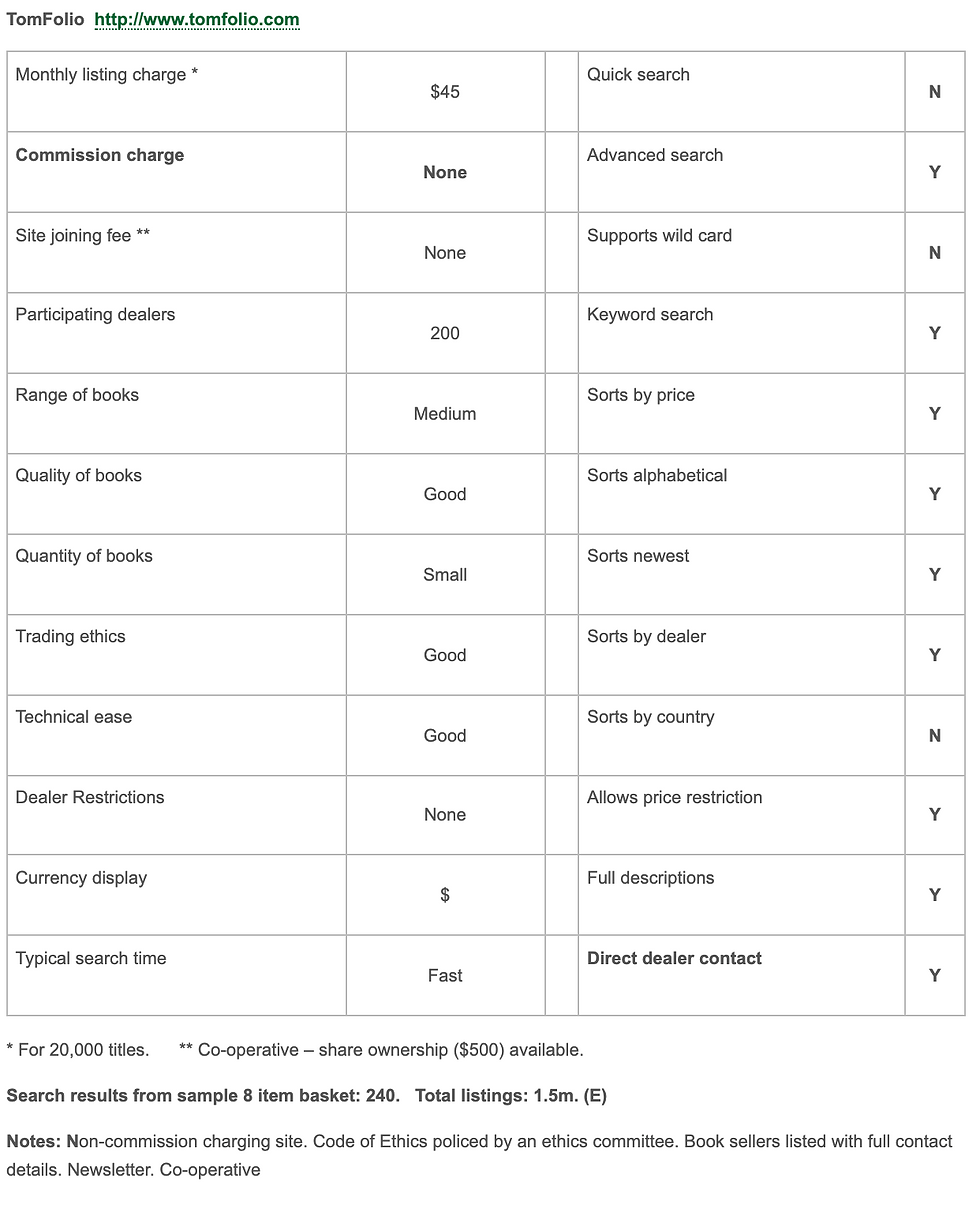
With all this in mind, we have assembled an at-a-glance cross-table showing the main strengths and weaknesses of each site. Some areas are objective, such as listing fees, commissions, etc.; but others are, by force, subjective. We have done our best to be impartial, but are happy to listen to comments if you do not agree with our assessment.


Costs and performances on any given site can change. We will update to new information as it comes our way.


Detailed information on each site follows the cross-table.

Cross-Table Summary of all Significant

English Language Used/Antiquarian Listing Sites

Key: Positive factors are shown in GREEN and negative factors in RED. Neutral factors are shown in BLACK.


** Members only. *** Other options available     * Adjusted for the used/antiquarian book portion of traffic (E).

‘PRINT-ON-DEMAND’ photocopies clutter listings – sites where this is becoming a problem are marked thus: PoD


METASITES TRAFFIC


TRAFFIC & SALES : Each site is awarded stars based on Alexis and Google ratings, combined with known experience and such sales results that can be gleaned.

++++               = Mainstream site with heavy traffic, large range and proven sales.

+++                 = Significant traffic, range and sales.

++                    = Solid traffic, range and sales.

+                      = Established site, often with a niche market.

No stars          = New or limited site.

N.B. As noted on page 3, this is only a ROUGH GUIDE – quite apart from the imprecise nature of the ratings, any one site may be better or worse for a particular kind of book. So, although Traffic and Sales are vital factors when choosing a venue, or how likely they are to have the range of books you seek, we are only able to offer this very approx-imate guidance.


Detailed Breakdown of the Listing Sites

Notes: Only ABAA members may list here. Code of Ethics policed by an ethics committee. Although many items listed here will also be listed elsewhere, the site includes a higher than usual proportion of exclusive items. Wants service. Catalogue service. Stolen book database. News page. Newsletter.


NOTES:


1. The eight item shopping basket used in this guide was carefully chosen from common titles through to scarce titles or authors to get a snapshot of both the quantity, range and quality of each site. The items chosen were: grisham jury; tolkien hobbit; joyce ulysses; dickens copperfield; crawhall; dalvimart; shaw zoology; skerryvore.


2. The ‘Other Costs’ shown in the main cross-table tries to reflect the various costs, other than the basic fees or commission, that add to the sellers expense in using the site, such as the cost of dealing with Amazon’s mis-matches or eBay’s inability to deal with catalogues in a cost efficient manner.


One of the key factors to help a book seller to cope with the changing costs of listing on various book sites is to have a database that allows you to control your pricing according the site being used. Fail to do this and you will suffer diminished margins whenever adverse changes are made. Suitable databases for this purpose are BookRouter http://www.bookrouter.com; BookTrakkerhttp://www.booktrakker.com: or BookHound http://www.bibliopolis.com .


Whereas every effort has been made to display fairness and accuracy when producing this guide some areas are a matter of judgment and the terms, content and performance of listing sites constantly change. If you wish to report errors, changes, or comment, please contact the guide moderator: Stuart Manley stuart@barterbooks.co.uk .


The views expressed by the author of this guide do not necessarily reflect the views of the Independent Online Booksellers Association. Whereas every effort has been made to display fairness and accuracy when producing this guide, The Independent Online Booksellers Association is not responsible for errors or omissions.


Copyright © Independent Online Booksellers Association 2005. No part of this guide may be used, copied, reproduced, displayed, or offered without written permission of the Independent Online Booksellers Association.


Stuart Manley is co-owner of Barter Books, Alnwick, Northumberland, England, also online at http://www.barterbooks.co.uk


If the following comments sound pessimistic, they are not intended to be. The book trade will survive the present difficulties but I believe a certain measure of realism is in order.


Some three years ago there were about half a dozen book sites on the net. They all operated on the basis of a monthly subscription and dealers were in direct contact with their customers. The exception to this rule was Interloc/Alibris who listed uploaded inventories in their own name and charged the booksellers a commission on any sales. The bookseller never came into contact with the end customer.


At this point, two of my favourite sites, Bibliocity and Bibliofind were taken over by two of the major players, causing a chain reaction.


Among others, Sue and I, working as Collectable Books, were concerned that the sites where booksellers were in contact with their customers were disappearing. With our son, Andy, we started planning the structure and design of the book site that became http://www.bibliology.com and http://www.bibliology.com/classic. As it turned out, we were not the only ones, since other small, independent sites began emerging around the same time. Nobody could have foreseen the global political and economic changes that were to hit the world during the ensuing two years. Sadly, today we all know 9/11, Worldcom, Enron, Iraq and all the rest, only too well.


During the past eighteen months, many American booksellers have stopped attending European bookfairs. Similarly, European Community booksellers are apparently battening down the hatches, telling UK dealers about the poverty created by the Euro. Inseparable from the above causes, it is rumoured that some of the major London booksellers have cut down on buying because they are not selling as much as they used to. Whatever the true reason, the fact remains that the circulation of money in the used and antiquarian book trade has slowed to a relative trickle.


Of course, bookfairs and book auctions are but two of the easily visible parts of the book trade. Internet book sales are more difficult to feel and quantify but every independent online bookseller feels the downturn in the number and quality of books sold on the net. All of a sudden, in the book trade, as well as in the global business world, the name of the game has become ‘survival’.


If the book-buying public is worried about job security, interest rates, the value of the investment portfolio, the pension plan, the cost of raising children, etc, adding another wonderful book to the collection has become but one part of a postponed wish-list.

The pages of Bookfinder Insider, have been full of problems caused by monthly dues to book sites. Bibliology, unfortunately, has also lost a few members who say that in the present circumstances they simply cannot afford the subscription costs.


Some have suggested that instead of charging a regular subscription fee, Bibliology should turn itself into a commission-based site. This, of course, would fly in the face of one of the declared principles behind its setup: “Bibliology does not interfere in the relationship between booksellers and their customers. Books are listed on the basis of a monthly subscription, with the benefit of a secure ordering system. There are no further charges or commissions.” We continue to believe in this fundamental principle.


Bibliology has always responded to suggestions. When site visitors and subscribers felt uncomfortable with Bibliology’s black background we created a Light version which today is the Default format. We also continue with some added-value services. We offer free cataloguing software to members. Visitors to the site can register their ‘Wants’ – as lists or as individual titles – which are then matched against new uploads. Members can have a personalised Home Page at no additional cost. Some have chosen to use the Bibliology Search panel in their existing web sites, benefiting from the site’s sophisticated search parameters and secure ordering system. Literary Genius Limited, Bibliology’s parent company, can register domain names for Bibliology members for a very modest charge. Visitors to the site can view a growing calendar of book-related Events as well as Links to many useful book-related sites.


At last, “Accessibility” has become a universal requirement for internet sites requiring equal rights of access for everyone, irrespective of any disability a user may have. Literary Genius has just completed a project to ensure that all its websites (Bibliology included) comply fully with US Federal standards of accessibility. Why US instead of UK standards? The simple answer is that at present US standards are the most demanding.


Have a look at the range of services and facilities offered by other independent sites. These may easily justify the payment of a subscription.


Would a commission on sales cost less? Maybe, in the short term, but in the long run, as the independent book sites gain market share, we feel the subscription method will be better value for the bookseller and, indirectly, for the customer. We all know that the same book listed on commission-based sites is often 5% to 20% dearer than on subscription only sites.

At latest count there are about thirty book sites on the net, with more planned, offering an ever-growing range of choices to the bookseller.


– List your books in the name of the book site, have no contact with the end customer, and pay a commission to the site on orders received.


– List your books on the basis of a monthly subscription + a commission on the value of the sales, with direct contact between bookseller and the customer but where the book site may have quoted an unrealistic currency conversion rate and cost of postage.


– List your books on the basis of a monthly subscription, with direct contact between bookseller and the customer but where the book site may have quoted an unrealistic currency conversion rate and cost of postage.


– List your books on the basis of a monthly subscription, with direct contact between bookseller and the customer, without any interference from the book site.


Some of the above book sites are searched by the major sites-of-sites while others prefer to rely on their own “customer through the door” client base. TodayBookfinder searches 40 book sites (including some new-book dealers) while AddAll searches 15 used-book sites.

We feel this range of choices is vital to a healthy book-trade. One needs the diversity! We all know what can happen to a small town when a single mall opens up on the perimeter, but the final decision must be yours!


I suggest we all have a think about how we would like the second hand book market to look in 3, 5 or 10 years’ time. Should we consider if it is worth taking a leap of faith and supporting one, two or more independent sites? The instant rewards may be quite depressing but the alternative may be to become a stockholder for one of the majors. Or, perhaps we should err on the side of caution and list on one or more of each.


Tom Biro Director Bibliology Limited tom@bibliology.com


bottom of page